Columbian Restriction & the Blue gene
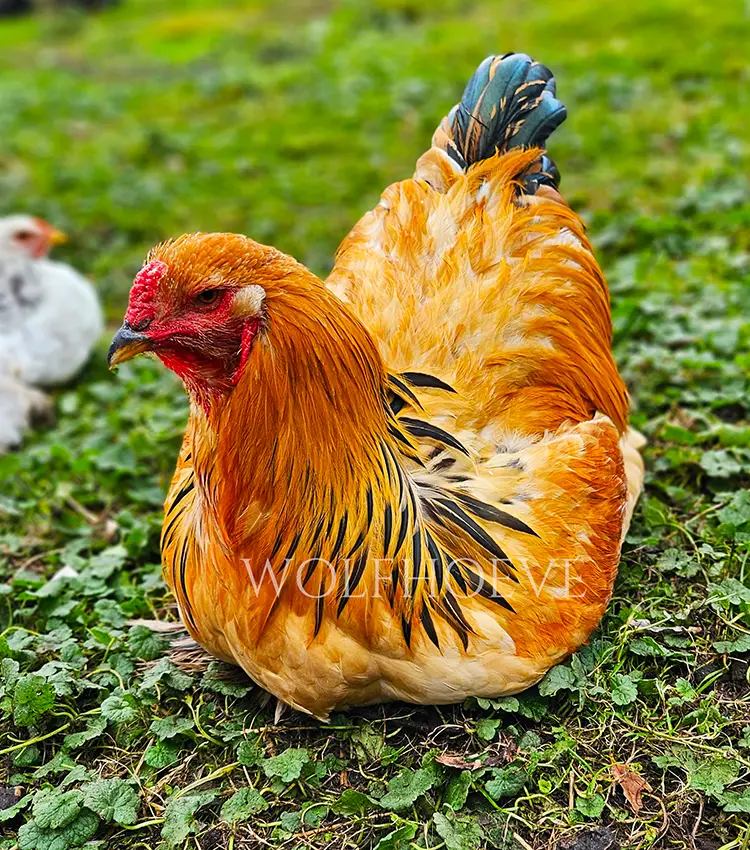
Buff Columbian Brahma
The Buff Columbian Brahma (often referred to as “Buff Brahma” in the United States) is one of the few colour varieties with strong historical recognition across major poultry standards. It was admitted to the American Standard of Perfection in 1924, giving it nearly a century as a standardised variety, and in Britain and Europe it is recognised under the name Buff Columbian. Genetically, it is defined by a golden-buff base colour with the Columbian (Co/Co) gene restricting black to the hackles and tail, leaving the rest of the plumage a rich buff.
This long-standing official status means breeders and judges expect Buff Columbians to display more than just the correct pattern: the buff should be deep, even, and free of smut, the hackles and tail should have clear black contrast, and the bird should maintain the correct Brahma type, with strong feathering, good size, and proper shank colour.
Although Buff Columbians are globally recognised, they are less common in exhibitions than the Light and Dark Brahmas, partly because producing the perfect shade of buff with clean markings is more difficult to achieve.
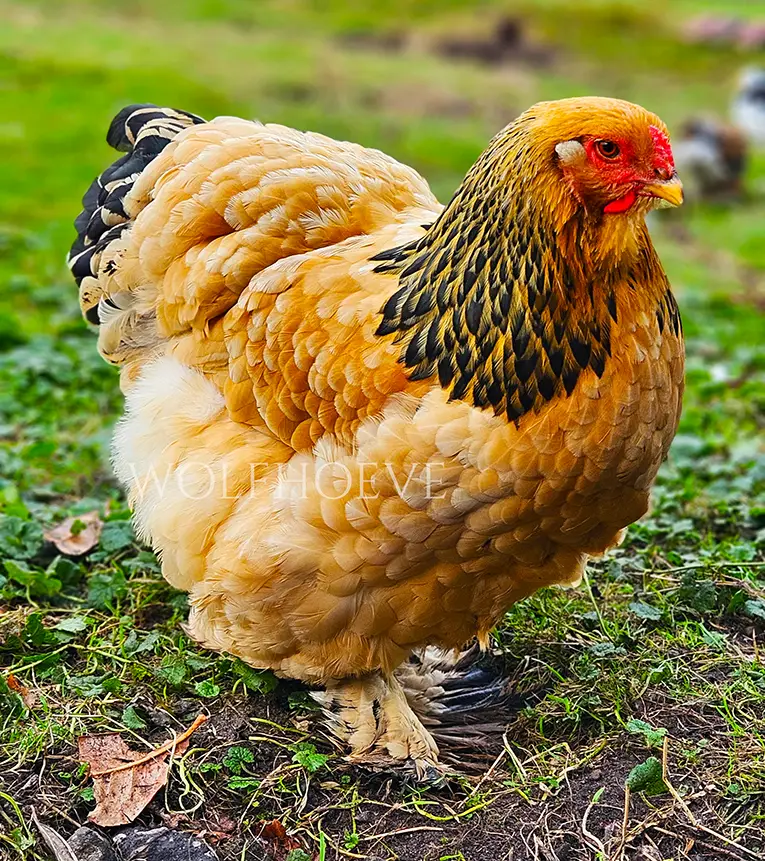
Buff Columbian Brahmas - visual guide
Buff Columbian is a recognised Brahma variety in European standards. Genetically it is a gold/buff base with Columbian (Co/Co) restricting black to hackles and tail. Breeder variants include Blue Columbian and Splash Buff Columbian, which follow the familiar Blue series inheritance. This guide describes the genotype of an individual chicken, rather than the genetic crosses involved in the breeding parents.
Buff Columbian - standard variety
Recognised in BrahmasBlue Columbian
Breeder variantSplash Columbian
Breeder variant - often called “Lemon Pyle” in BrahmasCommon breeder nickname: “Lemon Pyle” (no Dominant White)
Common confusion: Red Pyle vs Splash Buff Columbian
Different geneticsThey can look similar, but only Red Pyle uses Dominant White. Splash Buff Columbian is the Brahma usage often nicknamed “Lemon Pyle.”
Common confusion: pale buff tone ≠ Lavender
Shade vs genotypeSelective breeding for lighter or darker buff can shift body hue without adding new dilution genes. A creamy buff does not imply Lavender or Dominant White is present.
Examples & variants
| Name | Genotype elements (approximate) | Body colour | Hackles/tail colour | Notes |
|---|---|---|---|---|
| Buff Columbian | s+ base + Columbian (Co/Co) | Rich buff | Black | Recognised standard variety |
| Blue Columbian | Buff Columbian + Blue (Bl/bl+) | Buff | Slate blue | Shows incomplete dominance of Blue |
| Splash Buff Columbian | Buff Columbian + Splash (Bl/Bl) | Buff to lemon | Very pale blue to whitish | Often nicknamed “Lemon Pyle” in Brahma circles |
| Red Pyle (exhibition concept) | Red/gold base + Dominant White (I) | Red/gold | White wings/tail | Not the same as Splash Buff Columbian |
Breeding outcomes
The Blue gene is dosage-sensitive. This guide describes paired from each parent, rather than the individual genetic results in the offspring as described in the above. Use this guide for expected chick percentages:
| Cross | Buff | Blue Buff | Splash Buff – Lemon Pyle |
|---|---|---|---|
Buff × Buff (bl/bl × bl/bl) | 100% | 0% | 0% |
Buff × Blue (bl/bl × Bl/bl) | 50% | 50% | 0% |
Buff × Splash (bl/bl × Bl/Bl) | 0% | 100% | 0% |
Blue × Blue (Bl/bl × Bl/bl) | 25% | 50% | 25% |
Blue × Splash (Bl/bl × Bl/Bl) | 0% | 50% | 50% |
Splash × Splash (Bl/Bl × Bl/Bl) | 0% | 0% | 100% |
Percentages are expectations for large groups. Individual hatches can vary.