Mottled & Mottling in Brahmas
What is Mottling?
Mottling is caused by the mottling gene (mo/mo). It produces white spots on the tips of feathers by removing pigment from those areas. The effect can vary from small neat spots to larger irregular patches depending on selection and feather type. Unlike pencilling or lacing, mottling is not a pattern — it is the absence of pigment layered on top of another colour or pattern.
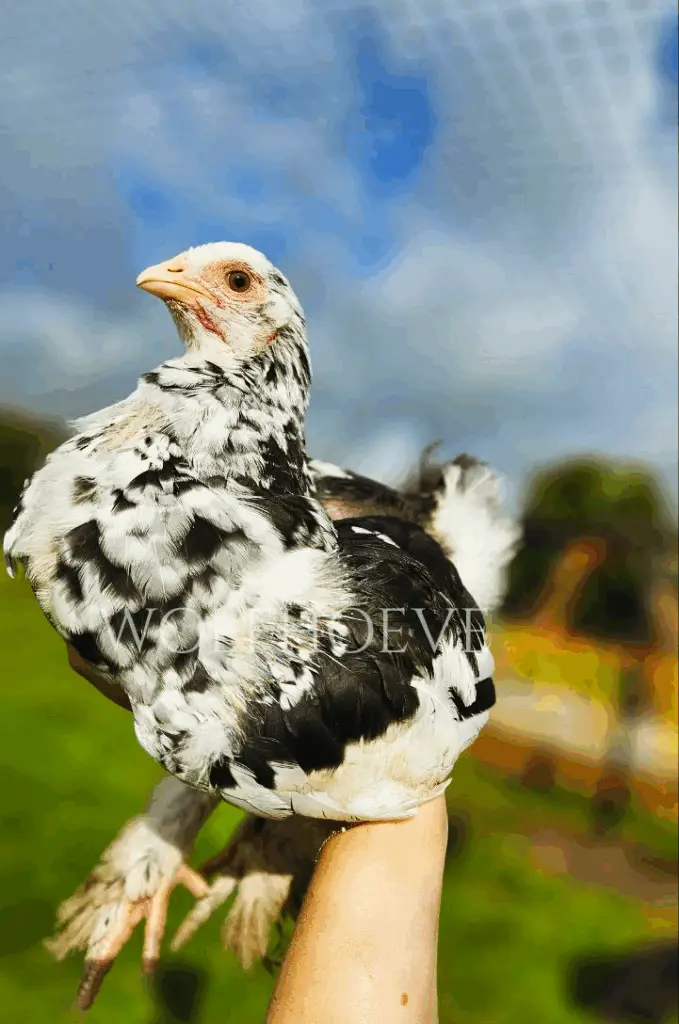
Black Mottled
The simplest form of mottling is seen on a black base. Feathers are black with white tips, giving a striking speckled appearance. This is the foundation for mottled and Mille Fleur project lines.
- Genetics: Extended black (
E) +mo/mo. - Appearance: black feathers with white tips.
Blue Mottled
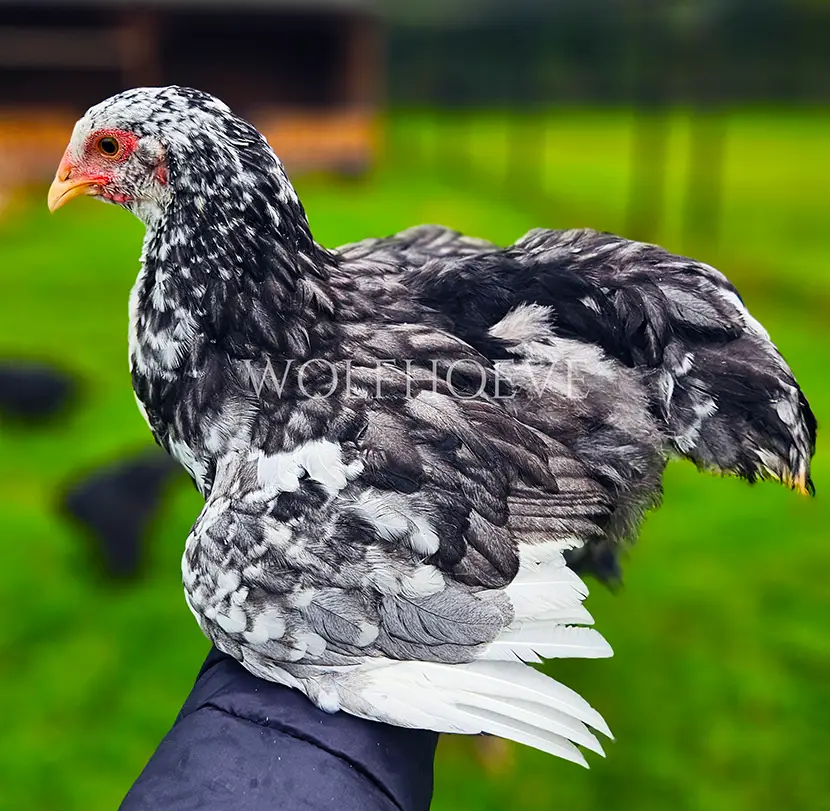
On a black base, mottling (mo/mo) produces feathers that are black with clean white tips, creating a speckled appearance. When the Blue gene (Bl/bl⁺) is introduced to that same genetic background, the black areas are diluted to slate blue, while the white tips remain, resulting in Blue Mottled. This gives a softer, more muted speckling effect compared to the sharper contrast of Black Mottled, and it is often used as a stepping stone in Mille Fleur and other patterned projects.
Genetics: Extended black (E) + mo/mo + Bl/bl⁺
Appearance: slate blue feathers with white tips
Mille Fleur
Mille Fleur (“thousand flowers”) combines mottling with partridge-type patterning. Each feather has three elements: a buff ground colour, a black crescent band, and a white mottled tip. The result is a golden speckled look.
- Genetics: Partridge base (
Pg,Ml,Db) +mo/mo. - Appearance: buff/red ground with black banding and white tips.
Porcelain is the lavender-diluted version of Mille Fleur. The lavender gene (lav/lav) softens black to lavender-grey and red to pale cream, while mottling still produces white tips. The combination creates a pastel Mille Fleur, with cream ground, lavender crescents, and white tips.
- Genetics: Mille Fleur +
lav/lav. - Appearance: cream ground, lavender banding, white mottling.
Mottled, Mille Fleur & Porcelain Brahmas - visual guide
All of these patterns build on the same genetic foundation: mottling (mo/mo). The base colour determines the background, and additional genes like Blue (Bl) or Lavender (lav) change how the mottling expresses.
Black Mottled
Foundation patternBlue Mottled
Black mottled + Blue geneMille Fleur
Gold + mottling + pattern genesPorcelain
Mille Fleur + LavenderExamples & variants
| Name | Genotype | Appearance | Notes |
|---|---|---|---|
| Black Mottled | E + mo/mo | Black feathers with white tips | Base form of mottling |
| Blue Mottled | E + mo/mo + Bl/bl+ | Slate blue feathers with white tips | Softer contrast than Black Mottled |
| Mille Fleur | s+ + mo/mo + Pg Ml Co Db | Golden feathers with black spangles and white tips | The “thousand flowers” effect |
| Porcelain | s+ + mo/mo + Pg Ml Co Db + lav/lav | Lavender ground, diluted spangles, white tips | Pastel version of Mille Fleur |
Breeding Notes
- Mottling (
mo) is recessive — both parents must carry it for chicks to show mottling. Mo/mocarriers appear solid and show no mottling.- Black × Mottled → all carriers (no mottling shown).
- Mottled × Mottled → 100% mottled offspring.
- Porcelain requires both mottling (
mo/mo) and lavender (lav/lav).