How do Brahma Colours Develop?
Introduction to the Basics
When it comes to chicken feather colours, things may look complex — but at the root, all colours come from just two pigments:
- Black (eumelanin)
- Red (pheomelanin)
A feather without pigment at all appears white. Every beautiful colour and pattern you see in Brahmas is simply a variation of how these two pigments are distributed, diluted, or modified by different genes.
Breeders have been tracking feather colours for over a century, long before DNA was understood. Through careful test matings in Europe and the US during the early 20th century, the main “groups” of genes were identified – base colours, ground colours, diluters, patterns, and modifiers. With the sequencing of the chicken genome in 2004, scientists confirmed and refined these categories at the genetic level, giving us the framework used today.
At Wolfhoeve, we breed rare and striking Brahma colour varieties. Each variety is shaped by different genes — the ‘ingredients’ behind their unique look. Below you’ll find the main groups of genes and the colours and patterns they create, explained in an easy way with examples from our own flocks.
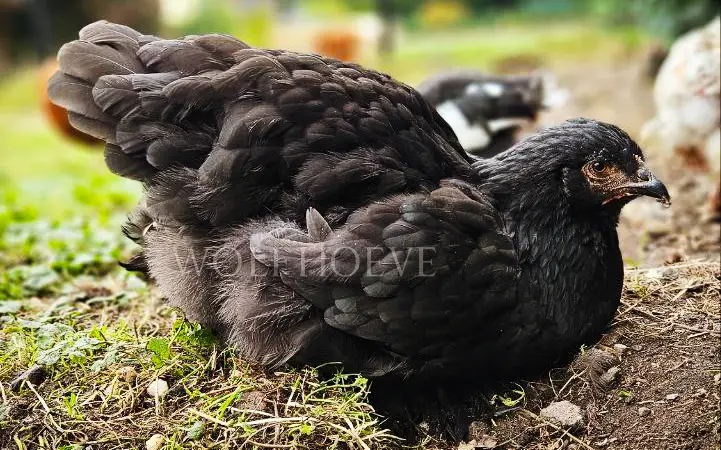
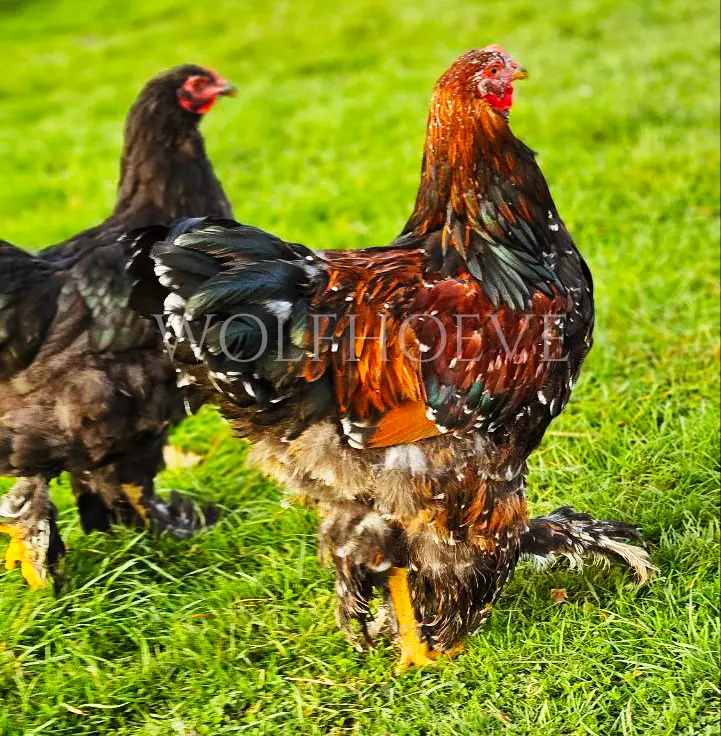
Why the Look Changes – The Genetics in Plain Language
Base sets the canvas: The E-locus (Extended Black, Birchen, Partridge, Wheaten, etc.) decides how pigment is spread across the body.
Ground colour & diluters recolour everything: Silver vs gold shifts highlights; blue, lavender, cream, and dun alter pigment itself, so each new feather shows the change.
Restrictors add contrast: Genes such as Co (Columbian) or Db limit where colour appears, creating the clean contrasts of hackles, saddles, and tails.
Patterns need adult feathers: Genes like Pg (pattern) and Ml (melanotic) arrange pigment into lacing or penciling, which only appears in true feathers, not chick down.
Maskers override all: Recessive white (c/c) covers every colour and pattern permanently.
These are each explained in the subsequent sections according to four groups.
Group 1 – Base Colours
The E-locus (base) sets the canvas of a chicken’s colour. It decides how black (eumelanin) and gold/red (pheomelanin) pigments are spread across the body. Every Brahma variety starts with one of these basis; the base is fixed from hatch.
| Base | Description & Buyer Notes |
|---|---|
| Extended Black (E) | Produces solid black birds with a rich green sheen. Buyers: These birds hatch dark and remain fully black into adulthood. |
| Birchen (ER) | Dark body with striking silver or golden hackles and chest. Buyers: Look for sharp contrast between hackles and darker body feathers. |
| Duckwing (e⁺) | Wild-type distribution, the natural ancestor pattern that underlies many rare varieties. Buyers: Shows natural striping in down; develops into patterned adults. |
| Partridge (eᵇ) | Base for classic penciled Brahmas – each feather grows with rich concentric markings. Buyers: Down appears chipmunk-striped; adult birds show detailed penciling. |
| Wheaten (ey) | Soft golden or buff base, common in lighter-coloured varieties. Buyers: Chicks hatch pale yellow or wheat-coloured; adults feather into buff or cream shades. |
Full beauty appears once adult feathers replace the down, as ground colours, diluters, or patterns are added. The base determines whether a bird grows up solid black, pencilled, or golden-bodied. For example, a Partridge base with the Columbian restrictor (Co) becomes a Columbian Brahma.
Group 2 – Ground Colours and Diluters
These genes change how the basic pigments (black and red/gold) appear. Some shift the ground colour (silver vs gold), while others dilute pigment to create blues, splashes, creams, or whites.
| Gene / Group | Description & Buyer Notes |
|---|---|
| Silver vs Gold (S vs s⁺) | Sets whether highlights look white/silver (S) or gold/cream (s⁺). Chicks: Fluff often looks similar regardless of allele. Adults: Hackles, wing highlights, and lacing reveal silver-white or golden-cream tones. |
| Blue / Splash (Bl) | Turns black into smoky blue (Bl/+) or pale splash (Bl/Bl). Chicks: May hatch charcoal or pale. Adults: Feather in smoky blue (Bl/+) or splash (Bl/Bl). |
| Lavender (lav/lav) | Produces an even pastel lilac-grey across the whole bird. Rare in Brahmas. Chicks: Pale grey down. Adults: Feather into a soft, even lilac tone. |
| Recessive White (c/c) | Masks all other colours, leaving a pure white bird. Chicks: Hatch yellow or white. Adults: Remain white for life; hidden colours stay masked. |
| Chocolate / Dun / Cream | Create softer brown, beige, or cream tones. Rare in Brahmas. Chicks: Differences in down are subtle. Adults: Muted shades appear more clearly after the first molt. |
Timeline tip: The first juvenile molt (10–16 weeks) reveals the true colour. Gloss, lacing, and penciling sharpen further with the next molt.
Group 3 – Colour Restrictors
These genes decide where colour appears, creating the clean contrasts and sharp patterns that make Brahmas stand out in the show ring.
| Restrictor | Description & Buyer Notes |
|---|---|
| Columbian (Co) | Removes colour from most of the body while leaving dark pigment in the hackles and tail. Creates Buff Columbian and Blue Columbian Brahmas with golden or white bodies and striking black hackle/tail contrasts. |
| Dark Columbian (Db) | An intensified version of Columbian that produces even deeper contrasts. Expect a bolder separation of light body colour and dark hackle/tail feathers. |
| Mahogany (Mh) | Deepens and enriches red or gold pigment, producing chestnut or mahogany tones. Birds with Mh have richer, darker reds that stand out compared to standard golds. |
| Melanotic (Ml) | Enhances black pigment and edging, crucial for sharp lacing and penciling. Essential for varieties with crisp black outlines around each feather. |
Buyer takeaway: Restrictor genes are what give Brahmas their dramatic contrasts and show-quality sharpness. They are the reason varieties like Buff Columbian look so clean and striking in the exhibition pen.
Group 4 – Feather Patterns
These genes create visual designs on each feather – the striking lacing, mottling, and barring that make certain Brahmas so eye-catching and collectible.
| Pattern Gene | Description & Buyer Notes |
|---|---|
| Lacing / Penciling (Pg + Ml + Co) | A combination of genes that arrange pigment into precise outlines or bands. Creates gold/blue laced, partridge, and pencilled Brahmas. Full sharpness develops after the first molts as feathers mature. |
| Mottled (mo) | Adds white tips to each feather. Foundation of Mille Fleur and Porcelain Brahmas. Chicks may show spotting early, but full effect is clearer in juvenile and adult plumage. |
| Barred / Cuckoo (B) | Creates alternating light and dark stripes across feathers. Rare in Brahmas, more common in other breeds. If present, produces distinctive striped patterns sometimes called “cuckoo.” |
Buyer takeaway: Pattern genes are the “fancy” layer that turn a base colour into something truly collectible. Mille Fleur, Porcelain, Laced, and Isabel Brahmas all depend on these patterning genes.
Bonus info! Genes, Loci, and Alleles – What’s the Difference?
In chicken colour genetics, it helps to know the basic language breeders and scientists use. Here’s a quick guide with real examples:
| Term | Definition | Example in Chickens |
|---|---|---|
| Locus | The fixed position on a chromosome where a gene lives – like the “street address.” | E-locus: the chromosome position that controls distribution of black/red pigment. |
| Gene | The stretch of DNA at a locus that influences a trait (like pigment type or placement). | The MC1R gene at the E-locus determines whether pigment is extended (solid black) or patterned. |
| Allele | A version of a gene found at a locus. Different alleles create different visible outcomes. | At the E-locus: – E = Extended black (solid black birds) – eᵇ = Partridge (penciled pattern) – ey = Wheaten (buff-based birds) |
Takeaway: Each locus is like an address, each gene is the code at that address, and each allele is a variation of that code. Breeders use the allele symbols (E, ey, Co, S, etc.) because those directly predict feather colour.